Books to Queer by: Review of 'Queer India Now'

1999. Bombay. Reading Facing the Mirror in crowded train compartments where it didn't matter who saw you, in secret nooks at the all-girls college, hoping someone did see you, I felt as if anyone who looked at the book and looked into my eyes would instantly know what I barely knew; that somehow just holding the book made me - was making me - queer. Of course it was. This is the power of books.
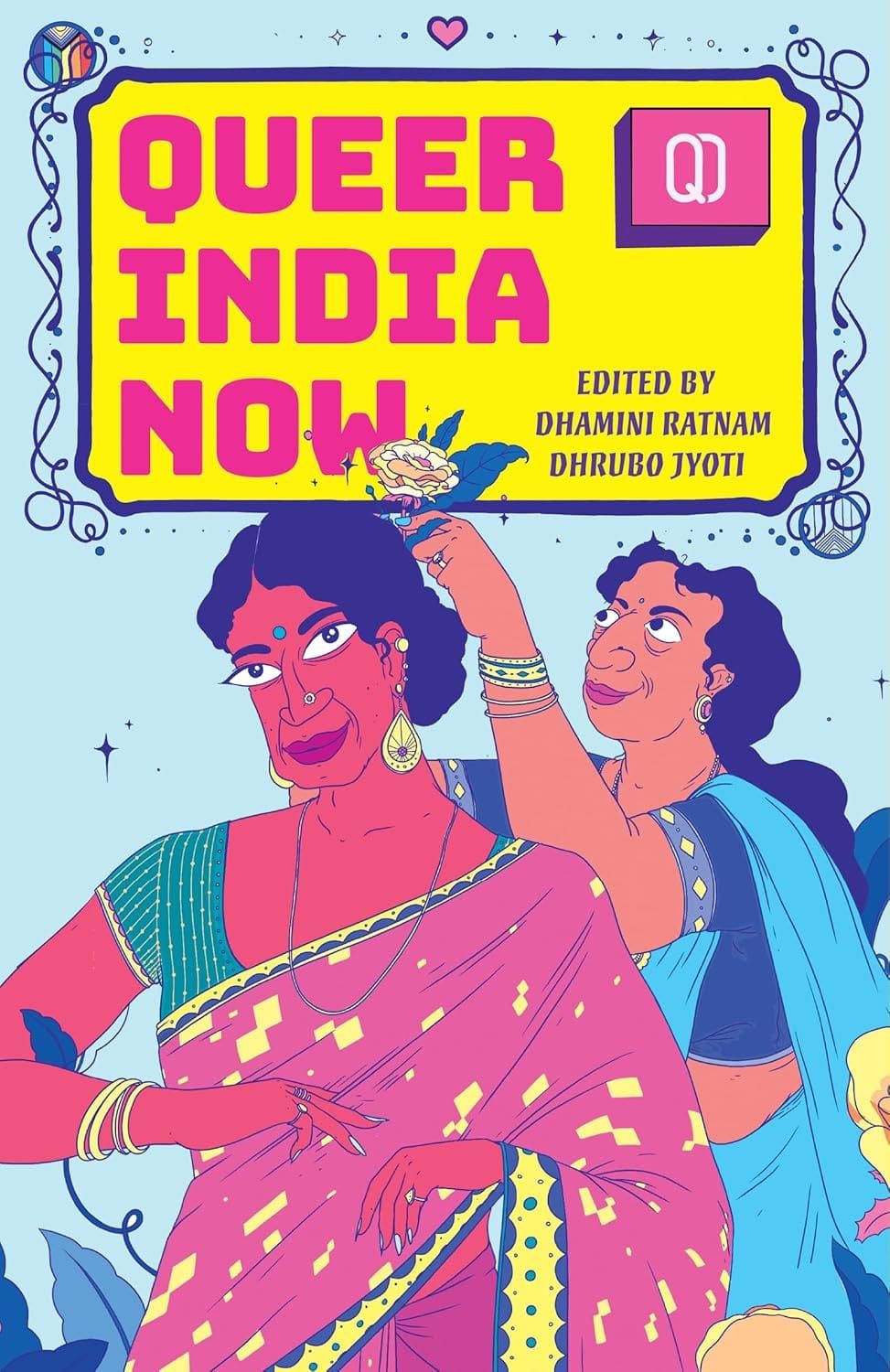
Fast forward to 2026, and wandering around Bengaluru's Blossom Bookstore with the bright pink-and-yellow Queer India Now tucked under my arm; an anthology of contemporary queer writing in India edited by Dhamini Ratnam and Dhrubo Jyoti.
Jilted-in-love Indian masculinity emerges newly in Vijeta Kumar's chapter "Love Mattre", where children matchmake by matching chappals outside boring functions, and broken hearted area bois return to their male friends to 'maalish [a] broken heart'. Liquid and lyrical, Vqueeram Aditya Sahai's poem, "Someday, I will be an old woman" moves with ease through unease, moving us immeasurably as it speaks of the gaps in (broken) bones that allow them to dance. Shripad Sinnakaar's "Begumpura" will break your heart some more with 'and water doesn't ask / what the caste of our thirst is' (where to maalish that now?).
More heart ache, more heartbreak (do we queers ever tire of that? I hope not) as queer life in small-town India unfolds with delightful glimpses in Dhrubo Jyoti and Dhiren Borisa's collection of stories in "Where you weren't looking", as dalits and savarnas fall and falter in love.
Some anthologies might have a unifying theme, but Queer India Now's "Introduction" sets the tone for a rich and layered reflection of queerness in the contemporary, anchored in cherished values of the Constitution. It asks – 'Does it mean anything to be queer in a society where touch was once regulated by the accident of birth and desire, and still is? Can you be queer when no one will rent you a home?'
And elsewhere, '...queer means many things….It is the friendship between people who love each other more tenderly than any bloodline could guarantee, dispelling the dark clouds of loneliness and aging.'
This is a collection that goes beyond stories of same-sex desire and gender non-conformity. It is as much an exploration of the 'India' in its title as it is the 'Queer'. And when the last two decades have seen the ossification of a saffron-savarna queer identity, Queer India Now could not be more timely. From Kashmir to Nagaland to Bolangir, the editors have painstakingly traveled the length of the country and the breadth of the community, seeking multiplicity, not uniformity of queer voices. One story ends with:
I hope caste discrimination ends. We need that more than marriage equality.
Another:The first and most pervasive feature of queer life in Kashmir is silence.
And another:
I learnt then that every right is a fight.
I am reminded of Audre Lorde's words that 'There is no such thing as a single-issue struggle because we do not live single-issue lives'. Courageously curated, brilliantly written, Queer India Now brings multiple, integral conversations together, drawing us into the complexities of queerness in India by creating a precious container of kindness for all of us to listen - to love that is shared, and realities that aren't.
Queer India Now, edited by Dhamini Ratnam and Dhrubo Jyoti, releases on
12th June at Bangalore International Centre, 6:30 PM
13th June at Bangalore Room, 6:00 PM.
Written by: Sami